Brother Hotchkins
The Captain and Ann BarbaraBrother Hotchkins presides over the Saturday evening entertainments at Morgan Chapel, the free concerts of music, recitations, and parlor accomplishments that draw the children of Wheeler Street's crowded tenement neighborhood out of their cramped homes and into a fairer world. He is the manager, the disciplinarian, the impresario, and the missionary of this weekly ritual, and in Mary Antin's account of him the reader meets one of the most sharply observed minor figures in her memoir of Americanization. His portrait is built from a paradox that the young Mary cannot resolve: she admires his efficiency utterly and dislikes him personally with equal conviction, and the tension between those two responses becomes a small drama about what it means to be a Jew, an atheist, and eventually an American.
The Master of the Programme
Brother Hotchkins's genius lies in his programmes, which Mary judges masterly with the authority of a regular attendee from Number 11. He intersperses classics of the lighter sort with the favorite street songs of the day, and he excludes anything that savors of the chapel, devoting the hour honestly to entertainment. The result is an exquisitely balanced compound of pleasure, wonder, and longing. The evidence of his success is written on the bodies and postures of his audience: knock-kneed men with purple noses, bristling chins, and no collars slouch in skeptically and sit tentatively on the edge of the rear settees, only to move nearer the front as the programme proceeds and openly join the applause at the end. Scowling fellows who enter with defiant faces occasionally slink out shamefaced. Both kinds sometimes remain to hear Brother Tompkins pray and preach, and Mary credits this conversion of the hostile and the indifferent entirely to Brother Hotchkins's masterly programme. The children behave well for the most part, and the few toughs who come in deliberately to make trouble are promptly expelled by Brother Hotchkins and his lieutenants.
The performers he introduces are as carefully chosen as the music. Beautiful ladies read or sing to the children, and the young audience hangs upon their lips, recognizing the quality of their approval; the ladies in turn do their best. Miraculously clean gentlemen sing or play, and the children applaud them as heartily as they applaud the performance itself. Sometimes the beautiful ladies are accompanied by ravishing little girls who stand up in a glory of golden curls, frilled petticoats, and silk stockings to recite pathetic or comic pieces with trained expression and practised gestures that seem to the juvenile Wheeler Street crowd the perfection of the elocutionary art. After these entertainments the children are all a little bit stage-struck, but more than that, they are genuinely moved by glimpses of a fairer world than their own, a world in which the beautiful ladies dwell with the fairy children and the clean gentlemen.
The Man Behind the Railing
Mary cannot help admiring Brother Hotchkins, he is so eminently efficient in every part of the hall at every stage of the proceedings. She always believes, though she never knows it for a fact, that he is the author of the alluring notices that occupy the bulletin board every Saturday. The way he handles the bad boys is masterly; the way he introduces the performers is inimitable; the way he does everything is the best way. Yet she does not like him and cannot. He is too slim, too pale, too fair; his voice is too encouraging, his smile is too restrained. The man is a missionary, and it sticks out all over him, and Mary cannot abide a missionary. She attributes this to the Jew in her, the European Jew trained by the cruel centuries of outcast existence to distrust anyone who speaks of God by any other name than Adonai. But she would resent the suggestion that inherited distrust is the cause of her dislike, for she considers herself freed from racial prejudices by the same triumph of her infallible judgment that has lifted from her the yoke of credulity. An uncompromising atheist such as she is at the age of fourteen is bound to scorn all those who seek to implant religion in their fellow men and thereby prolong the reign of superstition. Of course, she concludes, that is the explanation.
Brother Hotchkins, happily unconscious of her disapproval of his complexion, arises at intervals behind the railing to announce from a slip of paper that the next number on the programme will be a musical selection by such-and-such, until he arrives at his thanks to the ladies and gentlemen who have entertained the company that evening. As Mary moves toward the door with her companions, she hears his voice raised for the inevitable invitation to remain for a short prayer service, after which, a little louder, refreshments will be served in the vestry, and he will ask Brother Tompkins to lead the prayer. The rest is lost in the shuffle of feet about the door and the roar of electric cars glancing past each other on opposite tracks. Mary always gets out of the chapel before Brother Tompkins can do her any harm, and she reflects that there is nothing he could steal from her now that there is no God in her heart.
The Missionary's True Work
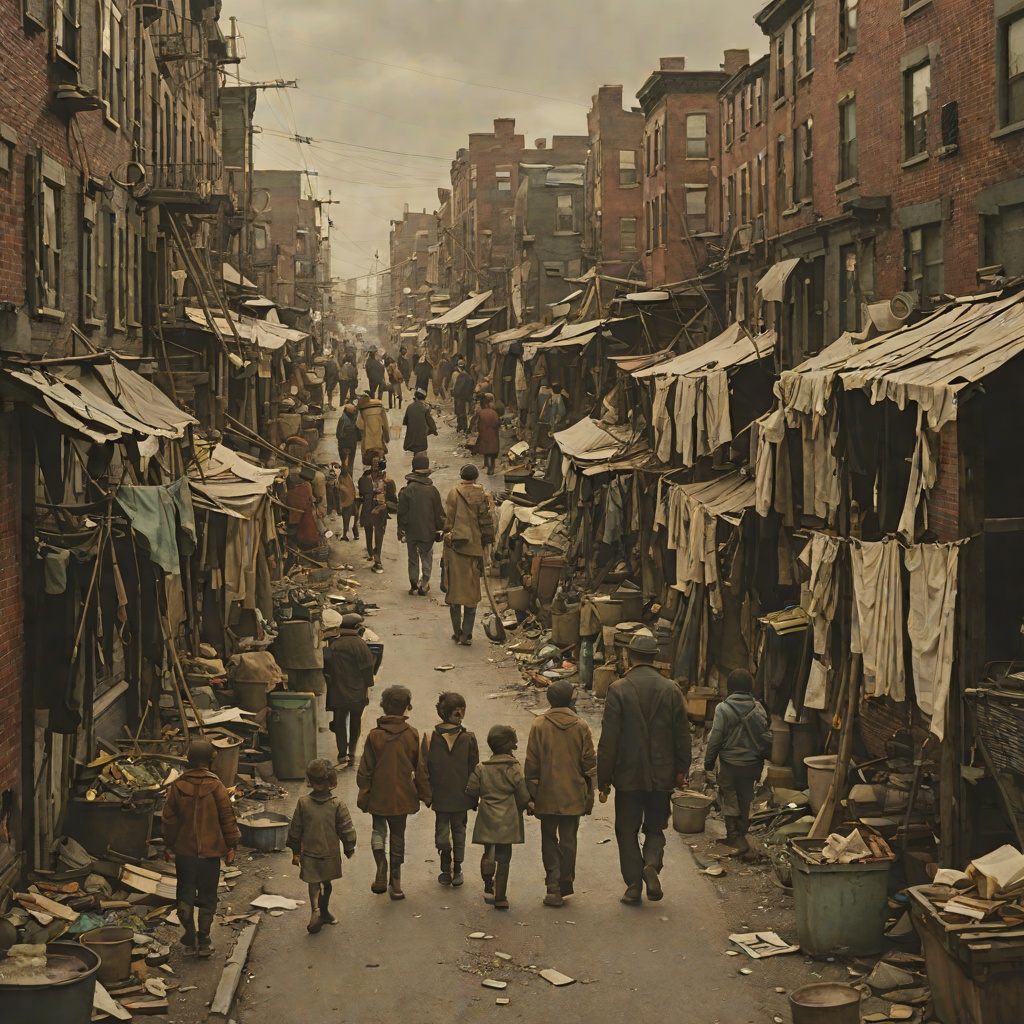
The mature narrator, looking back from a vantage point of deliverance from Wheeler Street, revises her adolescent verdict completely. If she were to go back to Morgan Chapel now, she would stay to hear Brother Tompkins and as many other brethren as might have anything to say; she would sit very still in her corner seat and listen to the prayer and silently join in the Amen. For she knows now what Wheeler Street is, and she knows what Morgan Chapel is there for, in the midst of those crooked alleys, those saloons, those pawnshops, those gloomy tenements. It is there to apply soap and water, and it is doing that all the time. She has learned, since her deliverance from Wheeler Street, that there is more than one road to any given goal. She should look with respect at Brother Hotchkins applying soap and water in his own way, convinced at last that her way is not the only way. Men must work with those tools to the use of which they are best fitted by nature: Brother Hotchkins must pray, and she must bear witness, and another must nurse a sick child or teach a class or write a book. The missionary whom the fourteen-year-old atheist scorned as the enemy of reason is recast as a fellow laborer in the same great work of lifting the poor and the outcast, using the only tools he has.
Narrative Role and Significance
Brother Hotchkins functions in the memoir as a test case for Mary's developing moral imagination. At fourteen she is certain that her dislike of him is the product of her own infallible judgment, her freedom from racial prejudice, and her uncompromising atheism; the mature narrator sees that it was in fact the inherited distrust of the European Jew, the very prejudice she thought she had transcended, masquerading as rational scorn. The portrait thus enacts the book's larger theme of self-knowledge arriving only after the fact, and it does so with unusual subtlety because the young Mary is not simply wrong: Brother Hotchkins really is a missionary, really does seek to implant religion, and really does stand for a worldview her atheism rejects. The mature narrator does not repudiate her younger self's perception so much as reframe it, recognizing that the missionary's method and her own are different roads to the same goal. The scene also dramatizes the social mechanics of Americanization at its most intimate level, showing how a free concert, a masterly programme, and a patient superintendent could draw the children of the tenements, and even the knock-kneed men with purple noses, into the orbit of a fairer world. Brother Hotchkins is the quiet engine of that transformation, and Mary's grudging admiration of his efficiency, set against her refusal to like him, captures the ambivalence of the immigrant child who wants the benefits of American institutions without surrendering her own hard-won independence of mind.